Seeing is Believing
The Museum of Arts and Design
2 Columbus Circle, New York, New York 10019 (walking directions in Google Maps, opens in a new tab)
Ongoing
Open Tue 10am-6pm, Wed 12pm-8pm, Thu-Sun 10am-6pm
Map
Smaller pins are other institutions within a mile of The Museum of Arts and Design
Coverage
- Stained Glass That Demands Slow LookingHyperallergic
- Judith Schaechter Explores Neuroaesthetics and the ...Hyperallergic


Exhibition Description
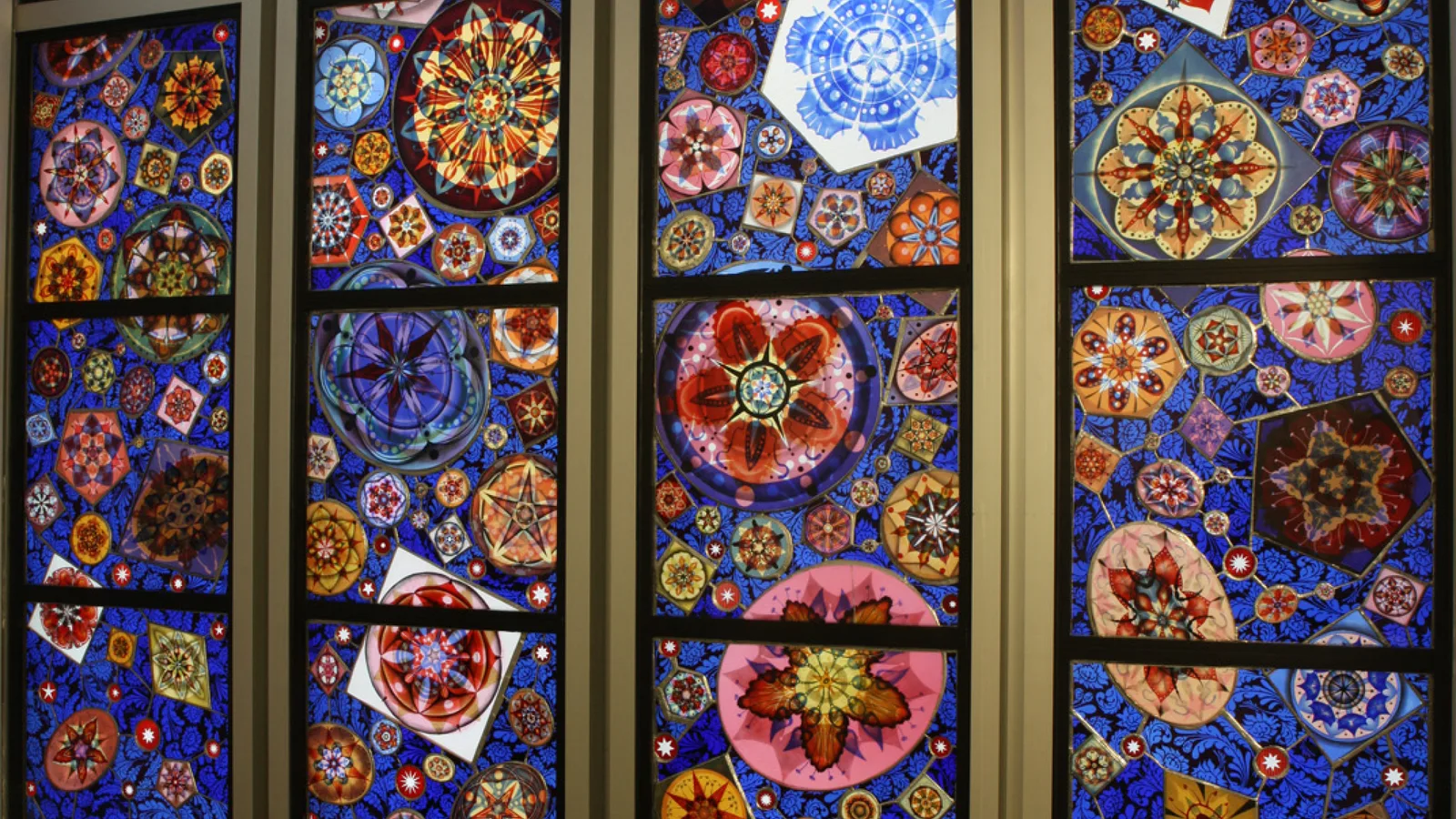
Located in the Museum's light-filled second floor stairwell (B), Judith Schaechter's Seeing is Believing was commissioned for the Museum of Arts and Design and installed when the Museum opened the doors to its new building in 2008. Schaechter's early career paralleled the high point of the Pattern and Decoration movement, which championed the use of ornamentation and female-driven subject matter in order to fight the legacy of male-dominated Modernist austerity. Seeing is Believing exploits the power of such patterning, in the form of two hundred unique, geometric images that evoke infinitely variable snowflakes, and brings to the fore what would usually be reserved for background design. Schaechter's work taps into the long-standing connection between stained glass and light that manifests itself in a sense of spirituality or holiness. Seeing is Believing is a contemporary reimagining of the medieval rose window, as evidenced in the kaleidoscopic arrangement of color and pattern.
A celebrated artist of contemporary stained glass, Schaechter's windows typically feature icons of contemporary life. Rather than the saints of traditional stained glass, Schaechter focuses on images of waifish women with large, sad, sunken eyes, whom she depicts in various states of conflict and transcendence. She taps into subconscious fears, dreams, and longing through her iconography, setting these protagonists against patterned backgrounds featuring natural imagery, fantastical animals, and geometric designs. Such elements bring to her work a seductive beauty that facilitates engagement with difficult subjects. Additionally, the patterned ground serves as a storytelling tool, creating context for the figural protagonist through the use of symbolism and supporting characters. The artist said that her backgrounds often imply the "possible psychological state, a hallucination, a dream, or even a visual representation of [the figure's] speech."
Source: The Museum of Arts and Design